






The UAP Summit 2026 was a technical and strategic conference focused on establishing a scientific, evidence-based foundation for understanding Unidentified Anomalous Phenomena (UAP). Attended by approximately 500 registrants, including academic scientists, former military pilots, legislators, and technology developers, the summit aimed to move the conversation from anecdotal reports to instrumented data collection.
https://uapsummit.org/events/uap-summit-2026/
We got invited to the UAP Summit. This page is a summary from NotebookLM.
Sources to NotebookLM: transcripts from @UAP_Summit/videos
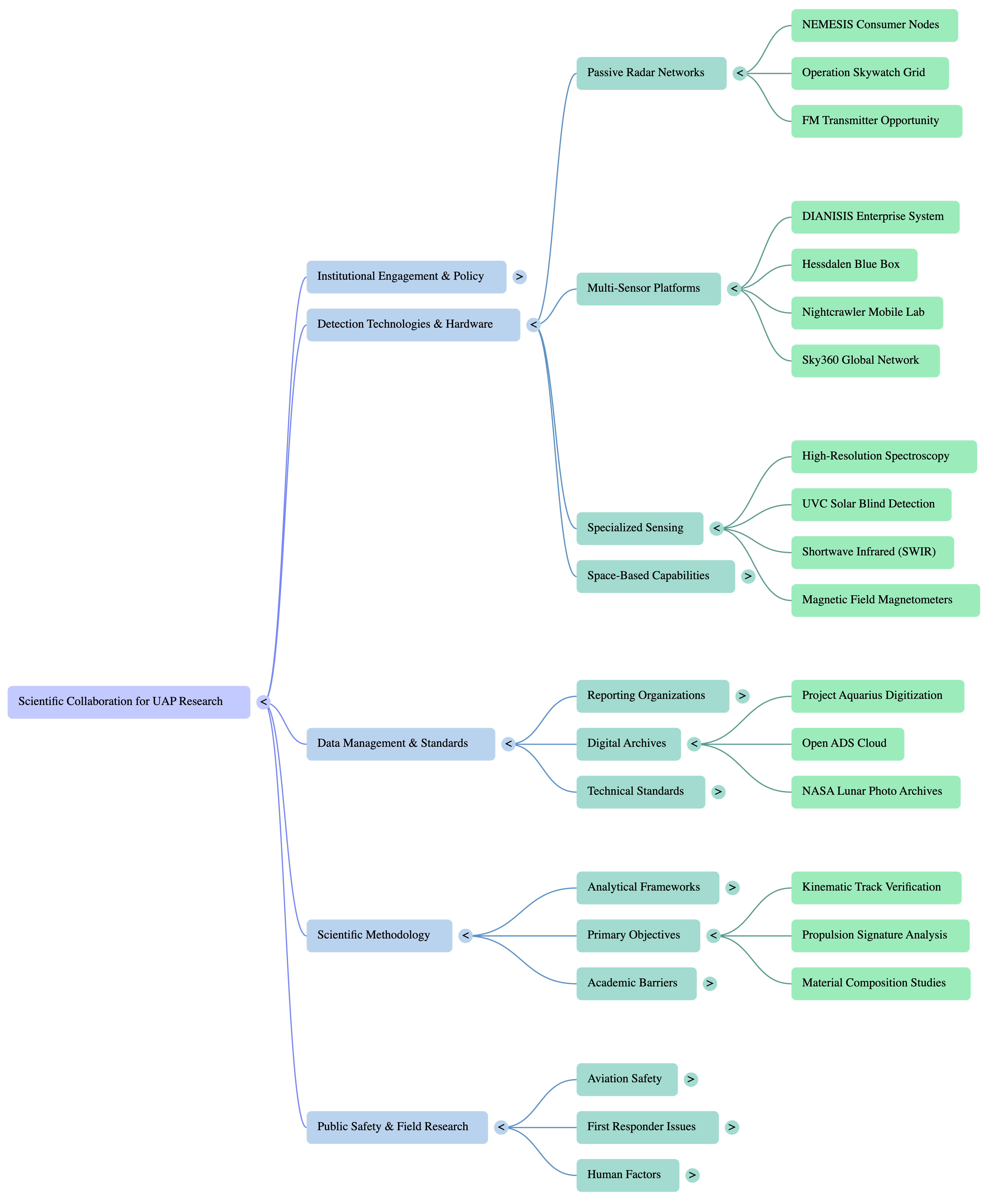
The summit’s central pillars included:
- The Ethos of "Data Drives Disclosure": Participants emphasized that credible, calibrated, and cross-validated data is the only viable path to professional scientific engagement and eventual government transparency.
- Technological Innovation in Detection: Speakers presented a variety of multimodal sensing systems—integrating radar, optical, infrared, radio frequency, and high-resolution spectroscopy—to correlate independent physical measurements of anomalous events.
- Distributed Citizen Science Networks: Recognizing that government data is often "stovepiped" or classified, the summit highlighted the importance of global civilian networks (such as Sky360 and Operation Skywatch) that use low-cost sensor nodes to provide geographic coverage and 3D triangulation.
- Institutional Advocacy and Policy: Discussions led by figures like Congressman Eric Burlison and Ryan Graves focused on aviation safety and national security, urging the FAA and NASA to integrate UAP reporting into existing safety systems (like ASRS) and to treat incursions near critical infrastructure as a serious homeland security mission.
- Combating Academic Stigma: Academic presenters shared strategies for navigating peer-review standards, seeking private funding, and utilizing artificial intelligence to review decades of unclassified NASA archives for historical anomalies.
- Behavioral and Multi-Domain Analysis: The summit explored the behavior of unidentified submerged objects (USOs) and the potential for UAPs to cause physiological effects or equipment interference, suggesting a sophisticated, non-human intelligence may be conducting long-term surveillance of human technological development.
Ultimately, the summit served as a "strategic solutions roadmap," advocating for a "team of teams" approach that combines civilian-led research with professional scientific rigor to build a "trust anchor" for the public

Commercial Hardware and Software for UAP Detection
Several organizations and private developers have created UAP detection systems and software specifically for purchase by citizen scientists and research institutions.
Commercial Hardware and Systems
- Nemesis (ELDÆON): This is a low-cost consumer passive radar node designed to detect aircraft, drones, and non-cooperative targets using existing broadcast signals. It is available for a total cost of $500, with a $50 deposit required to join a priority queue for delivery starting in early 2026.
- UAP Detector (Bill DePaola): A small, entry-level UAP detection device that is currently available on Amazon. A more advanced version is currently in beta testing and includes sensors for magnetic fields, RF emanations (1.6 and 10 GHz), ultrasonic/infrasonic sound, gamma rays, and UV.
- MSDAU (UFODAP): The Multi-Sensor Data Acquisition Unit is an electronics enclosure containing a Raspberry Pi, 3-DOF sensors (gyroscope, accelerometer, magnetometer), and a software-defined radio (SDR) scanning from 1 to 6000 MHz. These units and related accessories are available through the EUODAP shop.
- Pan Tilt DAU (UFODAP): A standalone, heavy-duty high-speed pan-tilt head that can carry various cameras and sensors, allowing them to point at and track the same target simultaneously.
- Dionis (ELDÆON): An enterprise-grade multi-sensor validation system equipped with 28 synchronized sensors across six modalities (audio, optical, RF, quantum, environmental, and biometric). While primarily intended for research labs, it is a "production-ready" system available for order.
Software and Subscription Services
- OTDAU Software (UFODAP): For $95, users can purchase a permanent license for this optical tracking software, which uses computer vision to identify and track moving objects, optically zoom in for detail, and filter out birds and aircraft.
- Sotera (ELDÆON): An augmented reality iOS application that tracks satellites in real-time, helping observers distinguish known objects from potential UAPs.
- ELDÆON Cloud Subscription: A service priced at approximately 19–20 per month provides users with cloud storage and access to advanced dashboard features for their Nemesis and Dionis hardware.
- MUFON Research Access: For 6permonth∗∗,members gain access to a searchable database of 145,000cases.A∗∗50 annual subscription provides access to the "Project Aquarius" digital library, which contains thousands of digitized historical documents and diaries.
Kits and Open-Source "Build-Your-Own" Options
Several speakers provide lists of parts and open-source software for users to build professional-grade systems at home:
- AIAA Consumer Systems: Michael Lembeck notes that a hemispherical high-res camera system using seven low-light cameras and Raspberry Pi processors can be built for under $1,000. A portable handheld environmental sensor system can be assembled for under $150 using Adafruit equipment.
- Sky360: This non-profit association provides schematics and manuals for citizen scientists to finance, build, and operate their own standardized, low-cost sensor stations using ABS plastic enclosures and open-source software.
- Robert McGwier’s GitHub: McGwier provides MIT-licensed code and instructions for building detection systems, including the "Richard Dolan USO Detector," which utilizes inexpensive $150 MEMS hydrophones to detect anomalous underwater sounds.
The Architecture of Anomalous Surveillance systems
The sources present a wide array of UAP detection systems ranging from global citizen science networks to highly specialized laboratory-grade mobile units and space-based platforms. These systems generally utilize a multimodal approach, combining various sensors to cross-validate anomalous events.
Radar Systems
Radar is frequently cited as the "holy grail" for UAP detection because it can track objects in darkness and provide precise kinematic data.
- Passive Radar: Several projects utilize "transmitters of opportunity" (like FM radio or TV signals) to detect objects without needing an FCC license.
- Nemesis (ELDÆON): A $500 distributed passive radar node designed for civilian deployment.
- Operation Skywatch: A planned national network of FM-band passive radar receivers for country-wide coverage.
- Kraken 5 SDR: A passive radar system developed by AIAA members using software-defined radio.
- Active Radar: Used by professional field teams for high-resolution tracking.
- The Night Crawler: Employs dual-geometry active radar (horizontal and vertical X-band) and millimeter-wave radar (K and KA band) to measure both linear and rotational velocity.
- Modified Military Radar: James Fowler notes that standard radar filters often "reject" UAP data, requiring modified load sets to detect objects with "signature management".
Optical and Imaging Systems
Cameras are the most common detection tool, but speakers emphasize the need for higher resolution and standardized metadata.
- All-Sky Cameras: Used for 24/7 360-degree surveillance. Examples include the SETI Kingsland 11-camera cluster, the UFODAP all-sky systems, and AIAA’s hemispherical high-res systems using Raspberry Pi processors.
- Pan-Tilt-Zoom (PTZ) Systems: These are often "cued" by radar or all-sky cameras to zoom in on targets. UFODAP’s OTDAU software automatically calculates target positions to point PTZ cameras for high-pixel-on-target captures.
- Thermal and Night Vision:
- FLIR/Infrared: Used to detect thermal signatures or objects invisible to the naked eye.
- PVS-14 Night Vision: Augmented with neural networks to flag non-linear motion.
- Democratized Pods: James Fowler advocates for gimbal-stabilized camera pods equipped with Inertial Measurement Units (IMUs) to turn standard DSLRs into scientific instruments by recording precise look-angles and GPS data.
Integrated Multi-Sensor Platforms
These systems serve as "validation hubs" that correlate data from dozens of internal sensors.
- Dionis (ELDÆON): An enterprise-grade system with 28 synchronized sensors across modalities including audio, electro-optical, RF, quantum, environmental, and biometric.
- UFODAP MSDAU: A multi-sensor data acquisition unit containing a 3-DOF gyroscope, accelerometer, magnetometer, barometer, and a software-defined radio (SDR) scanning 1 to 6000 MHz.
- Hessdalen "Blue Box": One of the longest-running automated measurement stations, featuring magnetometers, SDR radio wave detectors, infrasound sensors, and AI-driven sky cams.
Specialized and Niche Detection
- High-Resolution Spectroscopy: Massimo Teodorani proposes using high-resolution spectrographs to detect the "Zeeman effect," which could identify strong magnetic fields associated with UAP propulsion.
- Satellite Tracking Apps: Sotera uses augmented reality to help observers distinguish satellites from true UAPs.
- USO Detectors: Robert McGwier is developing the Richard Dolan USO Detector, which uses hydrophones to exploit the "cylindrical waveguide" effect in shallow water to detect anomalous underwater sounds.
- Atmospheric & Environmental Sensors:
- Solar-Blind UVC Detectors: Used by the Tedesco brothers to detect electrical discharges or "plasmoids" that would be invisible against the sun's background radiation.
- MADAR: A system designed to detect sudden changes in barometric pressure or magnetic gyrations.
Human and Archive-Based Systems
- ASRS (Aviation Safety Reporting System): Michael Gold recommends adding UAP reporting to this existing NASA/FAA system to turn every pilot and crew member into a "sensor".
- NASA Archives: A proposed "system" involves using AI and Machine Learning to review decades of unclassified NASA imagery for historical anomalies.
- MUFON's Andras System: An automated network database for research into citizen sighting reports.
- Earth Observation Satellites: Philippe Ailleris discusses using Synthetic Aperture Radar (SAR) and multi-spectral satellite data to analyze physical disturbances in remote regions.
Citizen Science and the Democratization of UAP Research
The UAP Summit 2026 characterizes volunteer work and citizen scientist groups as the essential backbone of UAP research, viewing them as the only viable path to large-scale data collection and eventual disclosure. Many speakers argue that because official government institutions have historically "systematically ignored" or "stovepiped" UAP data, the "race is on" for a distributed, civilian-led coalition to provide scientific clarity.The importance of these groups is highlighted in several key areas:
Global Detection Networks
Multiple presenters argue that a "monolithic" government solution is not scalable or likely to be shared with the public. Instead, they advocate for distributed citizen networks:
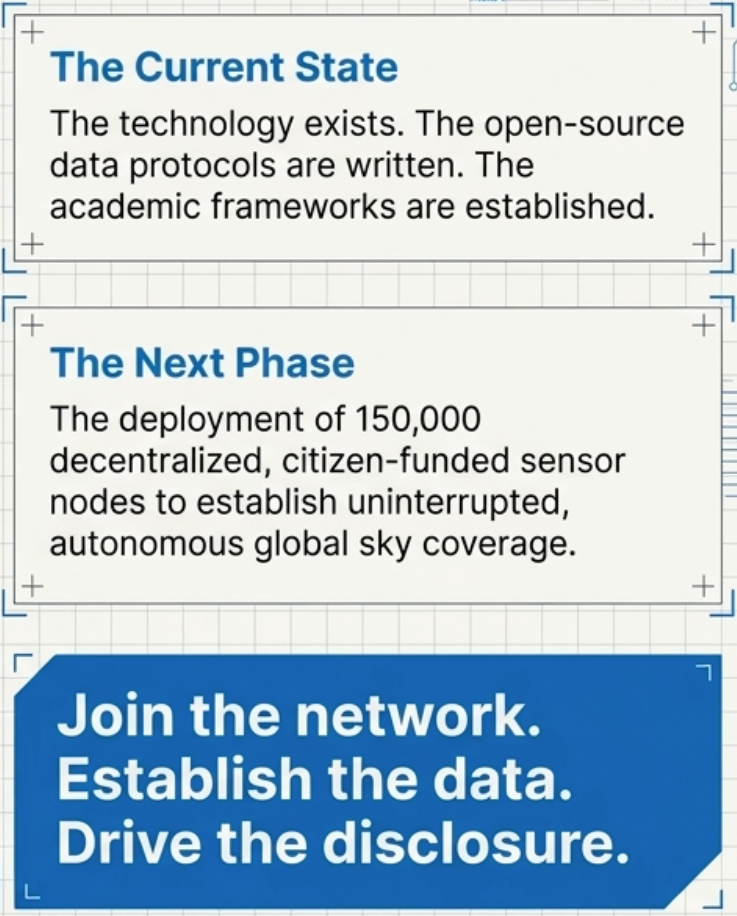
- Sky360: This project aims for a network of 150,000 global nodes. Richard Hopf states that citizen scientists are the only ones who can realistically finance, build, and maintain such a network because they focus on "return on objective" rather than "return on investment".
- Operation Skywatch: This initiative plans for a grid of 10,000 consumer nodes across the United States to ensure every anomalous object is triangulated by at least five receivers at once.
- ELDÆON: David Dominguez Hooper emphasizes that "infrastructure is fragmented" and that his company’s $500 passive radar nodes allow civilians to build "independent detection infrastructure" that provides geographic coverage military assets lack.
- UFODAP: Ronald Olch notes that his project has already established nearly 170 sites worldwide, driven by a community of citizen scientists sharing data and bug reports on platforms like Discord.
Trained Volunteer Investigations
Volunteer work is the primary engine for investigating historical and real-time sightings:
- MUFON: Robert Spearing notes that MUFON has been "doing the Air Force’s business since 1969" through its 700 trained forensic field investigators. He emphasizes that these are "volunteer, not amateur" professionals, often coming from backgrounds in the FBI, intelligence, geology, and astronomy.
- Project Hessdalen: This project is explicitly described as an "international volunteer-run citizen science project" and is one of the longest-running UAP investigations in the world, financed entirely through membership fees and private donations.
- Americans for Safe Aerospace (ASA): Ryan Graves’ organization utilizes 15 volunteers to help "make sense out of incomprehensible information" from over 1,000 pilot reports.
The "Democratization" of Science
The summit highlights a shift toward providing high-end tools to the general public to "weaponize" consumer equipment for defense and study:
- Open-Source Resources: Robert McGwier provides MIT-licensed code and instructions on GitHub for building "Richard Dolan USO Detectors" and other sensors so that anyone can participate in R&D.
- Accessible Hardware: Michael Lembeck of the AIAA shares part lists for backyard sensor systems costing under $1,000 and handheld environmental monitors for under $150, encouraging citizens to "build their own".
- Backyard Reporting: James Fowler calls for the democratization of gimbal-stabilized camera pods so that "grandma with her iPhone" can contribute data with scientific-grade metadata (IMU/GPS logs), which he believes is the only way to "skyrocket" the odds of capturing viable information.
Strategic Importance for Disclosure
The summit participants generally believe that "data drives disclosure" and that this data must come from the "inside out"—meaning from civilian scientists rather than waiting for a "revelation" from the Pentagon. By generating a "growing civilian coalition" that adheres to rigorous scientific standards, these volunteer groups aim to create a "trust anchor" for the public that remains independent of government censorship or "influence operations".